







In conversation with quilter Leslie Opp-Beckman
A fifth generation quilter and fiber artist based in the Pacific Northwest; Leslie Opp-Beckman is renowned for her impeccable hand stitching craftsmanship and thoughtful designs blending traditional techniques with a modern sensibility. Her work often explores and reflects themes of the natural world, resulting in pieces that feel both grounded and expressive.
Beyond her artistic practice, Opp-Beckman is also an educator. She served as Director of Innovative Programs at the University of Oregon’s American English Institute, where she focused on language teaching studies and the integration of technology in education. Through an introduction via mutual friends, Noah co-founder & interior designer, Estelle Bailey-Babenzien discovered Leslie’s work and a conversation began about creating a limited series of quilts utilizing deadstock Noah fabrics and materials to create unique one of a kind pieces.
They collaborated to conceive a collection inspired by the seascapes and nautical life. We're honored to exhibit this curation of her quilts in our Noah stores. We recently sat down with Leslie to learn more about her process, her practice, and the meditative nature of working with your hands.
When did you start making quilts?
I’ve been sewing for as long as I can remember—since I was about four or five—mostly with my mom and my Granny, and later with my sisters, cousins, and nieces. I also learned to use my mom’s old Singer Featherweight machine around that time. I was the official needle-threader in the house because my eyes were so sharp. I’ve always had my own little sewing kit, complete with needles, scissors, and threads. By elementary school, I was already making my own clothes and small quilts.
How did you learn this skill? Was this something that was passed down to you?
My Granny—who had twelve children—always had some kind of handwork in her lap. Even with just one hand, she was remarkably skilled at embroidery and made beautiful quilts from leftover fabric scraps collected from the many items of clothing she sewed for all of us—coats, aprons, pillowcases, potholders, shirts, dresses—you name it. My favorite dress in first grade was a plaid one she made just for me. She appliquéd a pony on the front and gave it a long, swishy tail made from red embroidery thread. I still have the childhood blanket she made for me, along with a couple of baby doll blankets that somehow survived years of constant laundering.
How has the tradition been kept alive and passed from one generation to the next?
On both sides of my family, the women immigrated to the United States in the late 1800s and early 1900s. They were all working-class people, and sewing and quilting were simply a way of life for as long as I can remember. The oldest family quilt I own was made by my great-great-grandmother, who pieced the back from old cotton work shirts and the front from a wool sample kit. I still have some of their fabric scraps and enjoy incorporating them into my own quilting projects for family members.


How do you find being an artist in the Pacific Northwest? Does the surrounding nature influence or inspire you in any way and reflect in your work?
My hometown is Portland, Oregon. These days, we live in northern Washington on the Olympic Peninsula. Being so close to both the ocean—the Salish Sea, just inland from the Pacific—and two beautiful mountain ranges, the Cascades and the Olympics, truly feeds my soul.
It’s been a joy collaborating with Noah, especially since we share so many common themes: water, oceans, wind, sails, wings, and the natural world. I also love that so many of Noah’s fabrics are derived from non-synthetic sources. Blending them into my daily textile work has been a real treat. Every quilt tells its own story, and now the Noah x LOB storylines are woven together.
I typically do machine sewing in the mornings and save handwork for the late afternoons or evenings—or when we’re on a long drive somewhere.
Talk to us about your studio practice. Where is your studio located? What kind of music do you like to listen to while you work? Do you work during the mornings, afternoons, or evenings? Do you have any rituals?
I live in an open-space structure with an upper roof garden and a lower deck, nestled within a pollinator garden—no grass!—and surrounded by both deciduous and evergreen trees, with views of the water and snow-capped mountains. It’s an immersive environment, with my “studio” woven throughout my home. I can see my works-in-progress at all times, even while doing other things.
I usually work without music, preferring to listen to the wind, the bees, and the neighborhood eagles and other birds. Deer and other critters regularly pass through our unfenced space, and I enjoy watching and listening to their movements.


Do you think there are some things that the hand can do that a machine can’t?
Yes, indeed! I embrace the “flaws” and “mistakes” that inevitably occur with hand work. They provide an opportunity to reflect and mend or perhaps head in a different direction. This is a fundamentally human (as opposed to machine) tactic or action.
Do you think about passing on all your knowledge to the next generation and is it important to you to know that your family's legacy will be carried on?
I have the honor of sharing my textile and quilt expertise—and resources—with family and friends of all ages. I love that the process looks different for each individual, and that together we’re continuing the traditions of generations before us. Maybe someday, one or more of the quilts I’ve helped create will be cherished and used in someone else’s life after I’m gone. It fills me with joy when I see a quilt I made years—or even decades—ago still alive, well-worn, and well-loved.

Does your family have a signature technique or style that you would say makes your quilts identifiable? Have there been any modifications or changes to techniques over time?
Our quilts are traditionally pieced from scraps left over from other projects, thrift store finds, and donated textiles. Occasionally, we gift each other new fabrics as a special treat, and we often exchange materials—especially when collaborating on quilts for special occasions like weddings, new babies, or to offer comfort during times of illness or loss.
My Granny’s approach—passed down to me—focused on working primarily with triangles of all shapes and pairing light fabrics with dark ones. Appliqué, embroidery, and embellishments such as ric-rac or lace were often added to her pieces, and these continue to be features in my own work as well. I love that Noah is actively upcycling their remnants through the “Not Dead Yet” program. It aligns beautifully with my own practices and values.
Talk to us about your quilting process. How long does it take start to finish and what are the steps in making a quilt like you did for Noah?
Every quilt begins with pieces left over from another. It’s a continuous process, with several projects always in motion—each one flowing into the next. I tend to work with whatever is on hand (my “stash” is constantly evolving), and I approach each quilt in an experimental mode, guided by the patterns or themes currently on my mind. The beautiful cotton remnants from Noah have mostly been shades of blue so far, inspiring themes centered around water, light, sails, wind, and the movements of the natural world—wind, weather, clouds, times of day, and seasons.
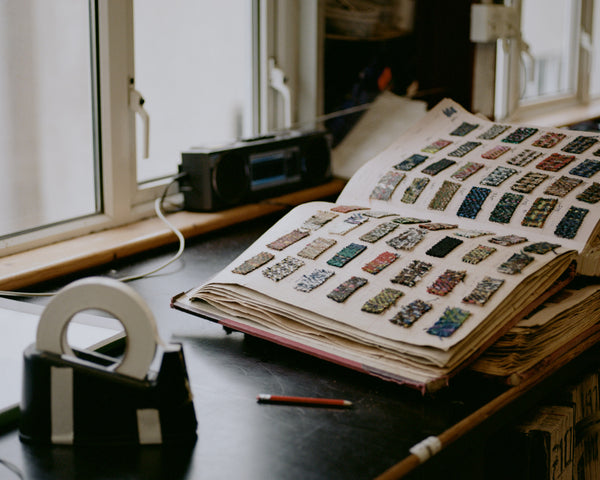
I begin by pulling together a palette based on one or more focus fabrics. This palette is made up of remnants and scraps in complementary and accent colors. From there, I start assembling what I think of as potential “elements”: blocks, strips, triangles, and other shapes; swatches and prints made with shells, wood, or linoleum blocks; embroidery threads; and other three-dimensional embellishments. There are always lots of piles everywhere!
Depending on the theme, I arrange the elements in ways that intuitively feel right. If something doesn’t quite work, I can cut it up and blend it into something else, or simply set it aside for another time. (These days, this is often referred to as “improv” work.) I then stitch the elements together, pausing often to check for cohesion and movement toward the desired effect. Sometimes it helps to step back and squint, or take a photo, to gain a fresh perspective. Quilts often take on a direction of their own and can end up in a final form I hadn’t anticipated.
Some quilts come together in just a day. Others take many days. Embroidery can be added at any stage. I often carry partially finished pieces with me so I can work on them while traveling, sitting by the fire, or visiting with family and friends.
Once the quilt top is fully pieced, I create a “sandwich” by adding a backing and placing a layer of batting in between. I usually work with cotton batting, though I sometimes use wool as well. The quilt layers then need to be secured. My grandmothers often tied their quilts or machine-quilted them—methods I still use. For a more refined finish, such as with the Noah quilts, I sometimes contract with a local longarm quilting specialist for edge-to-edge or custom quilting.
The final step is to add the binding around all four edges. I make my own binding and sew it on by hand. At this stage, I may also include final embroidery stitches or tiny patches where needed. Each quilt is entirely unique—designed to be durable, visually striking, and pleasing to the touch. In sum, a single quilt can take as little as a week or as long as a year to complete. The Noah quilts are typically taking 6-10 weeks, depending on the level of complexity.

Do you find a meditative quality to working with your hands and quilt making? Is this part of the process important to you?
This meditative, iterative rhythm is central to my creative process. I love the repetitive nature of hand stitching and machine sewing, and I find joy in watching how patterns and pieces gradually unfold. It feels like “pure stitchery” when the images in my mind come to life through the work of my hands.
If I get stuck, spending time outside—whether in the garden, on a walk, or on the water (rafting, kayaking, snorkeling, swimming)—helps me reset and reboot. Each quilt is entirely unique and created without a prescribed pattern, so sometimes they need to “percolate” for a while before reaching their final form.
In a technologically driven world, do you feel like a skill set such as quilt making is even more special, relevant, and important?
For me, sewing and quilt-making are ways to build and strengthen bridges with family and friends. And I like to think they help make the world a slightly warmer, more comforting place. I believe we transfer what’s in our hearts into the things we make—whether it’s food, quilts, or hand-carved wooden items.
Every Noah x LOB quilt is stitched with warm wishes and quiet joy. Whenever you see two side-by-side hand-embroidered knots, that marks a moment where I paused—two knots, in both Braille and Morse Code, symbolize a kind of comma or moment of stillness

What is something not known about you that you would like to share with our readers?
My academic training was in applied linguistics, and through that, I had the opportunity to connect—both online and in person—with educators and others around the world. Whenever I could, I brought back textiles—handwoven rugs, kitchen towels, lengths of local cloth—to integrate into our home. I love sewing puns (Noah fabrics are seeeeeeew fine!) and the practice of weaving textile-based items from different places and people into my everyday life.
Any last thoughts?
I hope the quilts now in Noah’s care will find good homes, and I would love to see photos of the places where they’re being used. Thank you for the Noah x LOB opportunity—this feels like the beginning of a wonderful journey we’re taking together!
When did you start making quilts?
I’ve been sewing for as long as I can remember—since I was about four or five—mostly with my mom and my Granny, and later with my sisters, cousins, and nieces. I also learned to use my mom’s old Singer Featherweight machine around that time. I was the official needle-threader in the house because my eyes were so sharp. I’ve always had my own little sewing kit, complete with needles, scissors, and threads. By elementary school, I was already making my own clothes and small quilts.
How did you learn this skill? Was this something that was passed down to you?
My Granny—who had twelve children—always had some kind of handwork in her lap. Even with just one hand, she was remarkably skilled at embroidery and made beautiful quilts from leftover fabric scraps collected from the many items of clothing she sewed for all of us—coats, aprons, pillowcases, potholders, shirts, dresses—you name it. My favorite dress in first grade was a plaid one she made just for me. She appliquéd a pony on the front and gave it a long, swishy tail made from red embroidery thread. I still have the childhood blanket she made for me, along with a couple of baby doll blankets that somehow survived years of constant laundering.
How has the tradition been kept alive and passed from one generation to the next?
On both sides of my family, the women immigrated to the United States in the late 1800s and early 1900s. They were all working-class people, and sewing and quilting were simply a way of life for as long as I can remember. The oldest family quilt I own was made by my great-great-grandmother, who pieced the back from old cotton work shirts and the front from a wool sample kit. I still have some of their fabric scraps and enjoy incorporating them into my own quilting projects for family members.
Does your family have a signature technique or style that you would say makes your quilts identifiable? Have there been any modifications or changes to techniques over time?
Our quilts are traditionally pieced from scraps left over from other projects, thrift store finds, and donated textiles. Occasionally, we gift each other new fabrics as a special treat, and we often exchange materials—especially when collaborating on quilts for special occasions like weddings, new babies, or to offer comfort during times of illness or loss.
My Granny’s approach—passed down to me—focused on working primarily with triangles of all shapes and pairing light fabrics with dark ones. Appliqué, embroidery, and embellishments such as ric-rac or lace were often added to her pieces, and these continue to be features in my own work as well. I love that Noah is actively upcycling their remnants through the “Not Dead Yet” program. It aligns beautifully with my own practices and values.
Talk to us about your quilting process. How long does it take start to finish and what are the steps in making a quilt like you did for Noah?
Every quilt begins with pieces left over from another. It’s a continuous process, with several projects always in motion—each one flowing into the next. I tend to work with whatever is on hand (my “stash” is constantly evolving), and I approach each quilt in an experimental mode, guided by the patterns or themes currently on my mind. The beautiful cotton remnants from Noah have mostly been shades of blue so far, inspiring themes centered around water, light, sails, wind, and the movements of the natural world—wind, weather, clouds, times of day, and seasons.
I begin by pulling together a palette based on one or more focus fabrics. This palette is made up of remnants and scraps in complementary and accent colors. From there, I start assembling what I think of as potential “elements”: blocks, strips, triangles, and other shapes; swatches and prints made with shells, wood, or linoleum blocks; embroidery threads; and other three-dimensional embellishments. There are always lots of piles everywhere!
Depending on the theme, I arrange the elements in ways that intuitively feel right. If something doesn’t quite work, I can cut it up and blend it into something else, or simply set it aside for another time. (These days, this is often referred to as “improv” work.) I then stitch the elements together, pausing often to check for cohesion and movement toward the desired effect. Sometimes it helps to step back and squint, or take a photo, to gain a fresh perspective. Quilts often take on a direction of their own and can end up in a final form I hadn’t anticipated.
Some quilts come together in just a day. Others take many days. Embroidery can be added at any stage. I often carry partially finished pieces with me so I can work on them while traveling, sitting by the fire, or visiting with family and friends.
Once the quilt top is fully pieced, I create a “sandwich” by adding a backing and placing a layer of batting in between. I usually work with cotton batting, though I sometimes use wool as well. The quilt layers then need to be secured. My grandmothers often tied their quilts or machine-quilted them—methods I still use. For a more refined finish, such as with the Noah quilts, I sometimes contract with a local longarm quilting specialist for edge-to-edge or custom quilting.
The final step is to add the binding around all four edges. I make my own binding and sew it on by hand. At this stage, I may also include final embroidery stitches or tiny patches where needed. Each quilt is entirely unique—designed to be durable, visually striking, and pleasing to the touch. In sum, a single quilt can take as little as a week or as long as a year to complete. The Noah quilts are typically taking 6-10 weeks, depending on the level of complexity.
How do you find being an artist in the Pacific Northwest? Does the surrounding nature influence or inspire you in any way and reflect in your work?
My hometown is Portland, Oregon. These days, we live in northern Washington on the Olympic Peninsula. Being so close to both the ocean—the Salish Sea, just inland from the Pacific—and two beautiful mountain ranges, the Cascades and the Olympics, truly feeds my soul.
It’s been a joy collaborating with Noah, especially since we share so many common themes: water, oceans, wind, sails, wings, and the natural world. I also love that so many of Noah’s fabrics are derived from non-synthetic sources. Blending them into my daily textile work has been a real treat. Every quilt tells its own story, and now the Noah x LOB storylines are woven together.
I typically do machine sewing in the mornings and save handwork for the late afternoons or evenings—or when we’re on a long drive somewhere.
Talk to us about your studio practice. Where is your studio located? What kind of music do you like to listen to while you work? Do you work during the mornings, afternoons, or evenings? Do you have any rituals?
I live in an open-space structure with an upper roof garden and a lower deck, nestled within a pollinator garden—no grass!—and surrounded by both deciduous and evergreen trees, with views of the water and snow-capped mountains. It’s an immersive environment, with my “studio” woven throughout my home. I can see my works-in-progress at all times, even while doing other things.
I usually work without music, preferring to listen to the wind, the bees, and the neighborhood eagles and other birds. Deer and other critters regularly pass through our unfenced space, and I enjoy watching and listening to their movements.
Do you find a meditative quality to working with your hands and quilt making? Is this part of the process important to you?
This meditative, iterative rhythm is central to my creative process. I love the repetitive nature of hand stitching and machine sewing, and I find joy in watching how patterns and pieces gradually unfold. It feels like “pure stitchery” when the images in my mind come to life through the work of my hands.
If I get stuck, spending time outside—whether in the garden, on a walk, or on the water (rafting, kayaking, snorkeling, swimming)—helps me reset and reboot. Each quilt is entirely unique and created without a prescribed pattern, so sometimes they need to “percolate” for a while before reaching their final form.
In a technologically driven world, do you feel like a skill set such as quilt making is even more special, relevant, and important?
For me, sewing and quilt-making are ways to build and strengthen bridges with family and friends. And I like to think they help make the world a slightly warmer, more comforting place. I believe we transfer what’s in our hearts into the things we make—whether it’s food, quilts, or hand-carved wooden items.
Every Noah x LOB quilt is stitched with warm wishes and quiet joy. Whenever you see two side-by-side hand-embroidered knots, that marks a moment where I paused—two knots, in both Braille and Morse Code, symbolize a kind of comma or moment of stillness
Do you think there are some things that the hand can do that a machine can’t?
Yes, indeed! I embrace the “flaws” and “mistakes” that inevitably occur with hand work. They provide an opportunity to reflect and mend or perhaps head in a different direction. This is a fundamentally human (as opposed to machine) tactic or action.
Do you think about passing on all your knowledge to the next generation and is it important to you to know that your family's legacy will be carried on?
I have the honor of sharing my textile and quilt expertise—and resources—with family and friends of all ages. I love that the process looks different for each individual, and that together we’re continuing the traditions of generations before us. Maybe someday, one or more of the quilts I’ve helped create will be cherished and used in someone else’s life after I’m gone. It fills me with joy when I see a quilt I made years—or even decades—ago still alive, well-worn, and well-loved.
What is something not known about you that you would like to share with our readers?
My academic training was in applied linguistics, and through that, I had the opportunity to connect—both online and in person—with educators and others around the world. Whenever I could, I brought back textiles—handwoven rugs, kitchen towels, lengths of local cloth—to integrate into our home. I love sewing puns (Noah fabrics are seeeeeeew fine!) and the practice of weaving textile-based items from different places and people into my everyday life.
Any last thoughts?
I hope the quilts now in Noah’s care will find good homes, and I would love to see photos of the places where they’re being used. Thank you for the Noah x LOB opportunity—this feels like the beginning of a wonderful journey we’re taking together!
